NetSuite Intelligent Performance Management: AI-Powered Business Planning

NetSuite Planning and Budgeting is a solution designed to address the budgeting and planning challenges that organizations face every day. It offers advanced tools, a centralized platform, integration with resources like Smart View for Excel, and a multidimensional database that enables more complex data analysis.
But what about artificial intelligence? Today, AI is the topic generating the most interest across all types of organizations. The key question is: how can AI be used to transform and optimize business processes? Within the NSPB universe, that question has been answered by one of its most powerful features: IPM.

Contents
What is IPM?
Intelligent Performance Management (IPM) is a data science module embedded within NSPB. It uses artificial intelligence and machine learning algorithms to analyze historical business data and generate predictions, identifying financial patterns that would otherwise require significant manual analysis and time to detect.
IPM replaces the need to search for and visualize patterns across multiple tools. Instead of reviewing dashboards, forms, and reports separately, IPM consolidates results in a single place and enables immediate action — for example, adjusting budgets directly based on the values predicted by the tool.
How is IPM accessed?
IPM is accessed from the NSPB Navigator under the IPM tile, which contains three tabs: Insights, Configure, and ML Models.

What tools does IPM include?
To support complex, automated analysis, IPM offers three core tools: Auto Predict, Insights, and ML Model Import.
Auto Predict
Auto Predict uses statistical methods to forecast values based on historical data provided to the system. It can process thousands of cells at once and write the results directly to a scenario within the cube, which is the part of the database where information is stored by type.
Predictions are configured according to business needs and can incorporate a complementary tool called Calendars and Events, which allows the system to account for strategic dates — positive or negative — that impact business activity. They can be run manually or scheduled to run at a defined frequency.

Insights
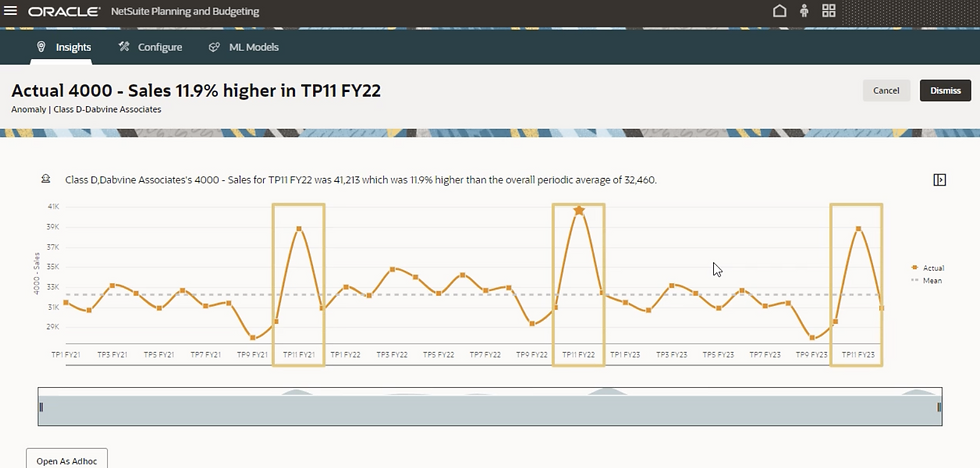
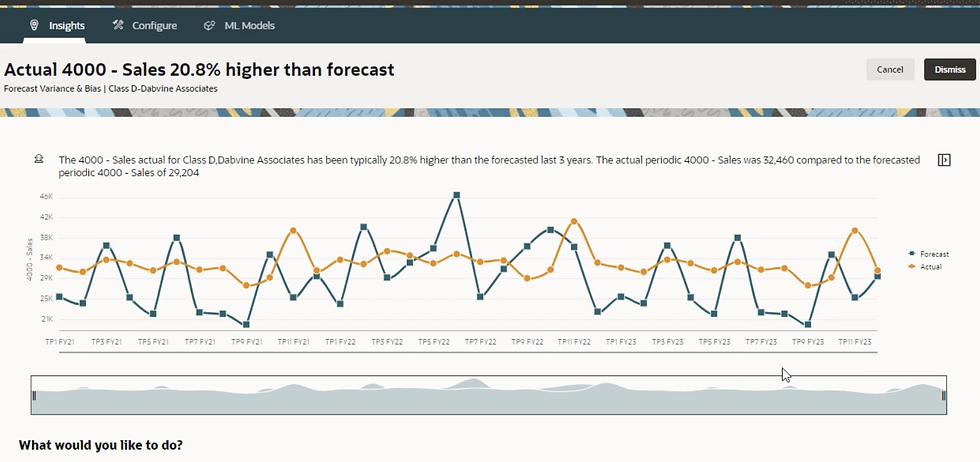
IPM Insights analyzes historical data and predictions to identify patterns automatically. There are three types of insights: Anomalies, Forecast Variances & Bias, and Prediction. Results are presented visually with a one-sentence summary, a chart, and supporting metrics — all in one consolidated view.
ML Model Import
What if your organization already has its own data science team and wants to use more complex machine learning models, built on the data available in NSPB? IPM covers that need as well. ML Model Import allows externally trained models to be imported into the system and mapped against previously configured dimensions. This type of model is typically used when analysis needs to consider multiple variables simultaneously.

What are the business benefits of IPM?
The key business benefits of IPM are:
Improve forecast accuracy by eliminating manual bias and applying statistical forecasting methods.
Detect trends early — IPM shifts teams from predictive analytics (searching for what you already know to look for) to prescriptive analytics (IPM tells you what to pay attention to).
Minimize forecast bias by analyzing the historical relationship between actuals and submitted forecasts, flagging consistent over- or under-forecasting tendencies.
Reduce time spent in analysis — rather than reviewing actuals after month-end close and searching for patterns across multiple tools, IPM surfaces results in one click.
Encourage collaboration through a built-in tagging and commenting system that routes insights to the right stakeholders.
Conclusion
NetSuite Intelligent Performance Management (IPM) extends the value of NSPB by embedding AI-driven capabilities directly into the planning process. By automating predictions, surfacing insights, and enabling more advanced modeling, IPM allows organizations to move from reactive analysis to proactive decision-making. The result is a more accurate, efficient, and scalable approach to business planning.
By Josefina C., Functional Consultant
Interested in learning more?
FAQS
What is IPM in NetSuite Planning and Budgeting?
IPM (Intelligent Performance Management) is a data science module embedded within NSPB that uses artificial intelligence and machine learning to analyze historical business data and generate predictions.
How is IPM accessed within NSPB?
IPM is accessed from the NSPB Navigator under the IPM tile, which contains three tabs: Insights, Configure, and Machine Learning Models.
What tools does IPM include?
IPM includes three core tools: Auto Predict (for generating statistical forecasts), Insights (for automatically identifying patterns), and ML Model Import (for incorporating externally built models).
What does the Auto Predict tool do?
Auto Predict uses statistical methods to forecast values based on historical data. It can process thousands of cells at once, and write the results directly to a scenario within the data cube.
What types of insights does IPM generate?
IPM generates three types of insights: Anomalies, Forecast Variances & Bias, and Prediction, each presented with a summary, a chart, and supporting metrics.
What is the Calendars and Events tool?
Calendars and Events is a complementary tool to Auto Predict that allows the system to account for key dates that positively or negatively impact business activity when generating predictions.
What is ML Model Import used for?
ML Model Import allows externally trained machine learning models to be imported and mapped against configured dimensions in NSPB. It is typically used when analysis needs to consider multiple variables simultaneously.
Does IPM replace manual review of reports and dashboards?
Yes, IPM consolidates results in a single place, eliminating the need to review dashboards, forms, and reports separately, and enables immediate action, such as adjusting budgets directly.
What are the main business benefits of using IPM?
IPM’s key benefits include improved forecast accuracy, early trend detection, minimized forecast bias, reduced time spent on analysis, and encouraged collaboration through a built-in tagging and commenting system.
What types of organizations benefit most from IPM?
Organizations already using NSPB that want to optimize their planning and budgeting processes through automated predictions and early pattern identification benefit most from IPM.


